When you own a rental property in Arizona, an air conditioner isn’t just another appliance. This is especially true for rental owners in growing West Valley communities like Buckeye, where extreme summer temperatures can quickly turn an AC failure into an urgent maintenance issue.
For rental property owners, a home warranty can provide valuable protection against the unexpected cost of repairing or replacing an HVAC system. But there is another side of home warranty coverage that landlords should consider: What happens to your tenants while you are waiting for the AC to be repaired?
That’s why Arizona landlords should look beyond whether an air conditioner is simply “covered” by their home warranty. Repair timelines, authorization requirements, coverage limits and even possible tenant lodging benefits are worth understanding before an emergency happens.
What Does a Home Warranty Typically Cover?
.
A home warranty, sometimes called a home service contract, is different from homeowners insurance. Home warranties generally cover the repair or replacement of certain home systems and appliances that fail because of normal wear and tear. Depending on the contract, that can include the home’s air-conditioning system.
For a rental property owner, this coverage can be valuable. A major HVAC repair or replacement can be expensive, and a home warranty may help reduce the owner’s out-of-pocket costs.
However, coverage varies considerably from one contract to another. There may be service fees, coverage limits, exclusions and requirements that must be met before a repair or replacement is authorized.
This makes it important for landlords to read the details of their specific plan rather than assuming all home warranties provide the same protection.
The Challenge With an AC Warranty Claim in an Arizona Rental
A home warranty claim doesn’t always mean an HVAC technician arrives and immediately completes the repair. Whether you own a rental property in Goodyear or elsewhere in the West Valley, several days without adequate cooling can become a much bigger issue than simply waiting for a covered appliance to be repaired.
Depending on the warranty company and the problem, the process may involve:
Opening a claim
Waiting for an assigned contractor
Scheduling a diagnostic appointment
Receiving the contractor’s diagnosis
Waiting for authorization from the warranty company
Determining what the warranty will and will not cover
Ordering parts or equipment
- Scheduling the final repair or replacement
Most of these steps are understandable. The warranty company needs an opportunity to diagnose the problem and determine whether it falls within the terms of the contract.
The challenge for an Arizona landlord is that the tenant is still living in the property while this process is taking place.
When temperatures are extremely high, several days without adequate cooling can become a much bigger issue than simply waiting for a covered appliance to be repaired.
Arizona Landlords Still Have Responsibilities When the AC Goes Out
.

Arizona law places certain responsibilities on landlords when it comes to cooling a rental home.
Under A.R.S. § 33-1324, landlords are generally required to maintain supplied air-conditioning equipment in good and safe working order and provide reasonable air conditioning or cooling when required by seasonal weather conditions.
Arizona law also provides certain remedies to tenants when a landlord deliberately or negligently fails to supply required air conditioning, cooling or other essential services. Under A.R.S. § 33-1364, after reasonable notice and when the statutory requirements apply, one potential remedy is for a tenant to obtain reasonable substitute housing during the landlord’s period of noncompliance.
The important lesson for rental owners is that a home warranty claim and a landlord’s responsibilities to the tenant are two separate issues.
Understanding who is responsible for repairs and other expenses can sometimes be confusing for both owners and renters. For a broader look at these responsibilities, read our Tenant vs. Landlord: Who Pays for What in Arizona Rentals? guide.
Waiting for a warranty company to approve an AC repair does not automatically put landlord-tenant responsibilities on hold.
?
One Question Landlords May Not Think to Ask: Does My Warranty Cover Tenant Lodging?
.
This is something rental property owners should investigate before they have an AC emergency.
Review your home warranty contract or contact your warranty provider and ask:
If a covered AC system fails and my rental property becomes temporarily unsuitable for my tenant, does my plan provide any reimbursement for hotel or temporary lodging expenses?
Don’t assume lodging is covered, but don’t assume it isn’t either.
Depending on the warranty plan, there may be additional benefits, optional coverage, reimbursement provisions or specific conditions that apply. These benefits may not necessarily be what an owner focuses on when initially purchasing a home warranty.
If lodging or temporary accommodation benefits are available, find out:
- What circumstances qualify?
- Is there a maximum amount per night?
- Is there a maximum total reimbursement?
- How many nights can be covered?
- Does the AC repair have to be approved as a covered claim first?
- Does the lodging need to be authorized in advance?
- Are receipts required?
- Does the benefit apply to a tenant-occupied property?
- Are portable or temporary cooling options covered?
Knowing those answers ahead of time can make an AC emergency much easier to navigate.
A Real-World AC Warranty Experience
We recently dealt with an AC failure at an Arizona rental property managed by E&I Real Estate & Property Management.
The property had a home warranty, so the owner understandably wanted to utilize the coverage available under the plan.
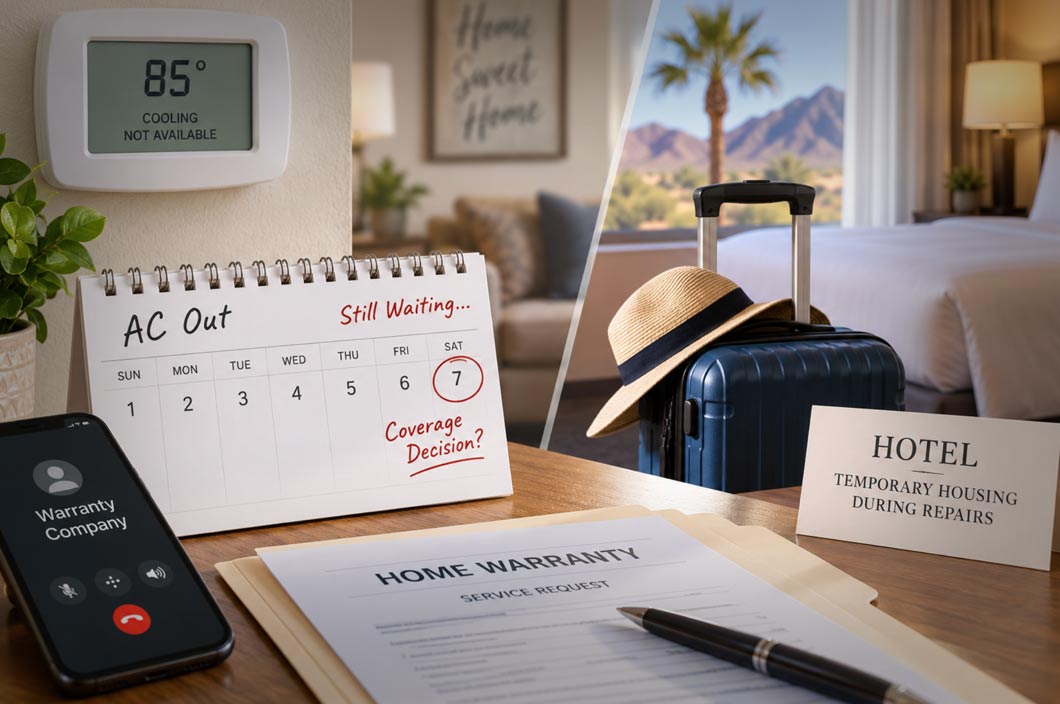
However, it took approximately seven days to receive a determination from the warranty company about what it would cover.
Meanwhile, there was a tenant occupying the property without the home’s normal air conditioning. Temporary accommodations were provided, however the overall disruption lasted approximately 12 days.
This wasn’t necessarily a reason not to have a home warranty. In fact, depending on the repair and coverage, a warranty can potentially save an owner a significant amount of money.
Instead, the experience highlighted something we believe rental owners should consider:
AC coverage isn’t only about who pays for the repair. It’s also about what happens while everyone is waiting for that repair to happen.
The Potential Benefits of a Home Warranty for Landlords
There are good reasons an Arizona rental property owner may choose to maintain a home warranty.
A warranty can help reduce the financial uncertainty associated with major repairs. Instead of suddenly facing the full cost of a covered HVAC repair or replacement, the owner may have coverage subject to the terms, limits and service fees of the contract.
A warranty can also provide a process for finding and dispatching service providers, which some owners appreciate. Particularly owners who don’t live near their rental property.
For an expensive system like an air conditioner, that protection can be valuable.
The Trade-Off: Cost Savings vs. Control
The potential trade-off is that when a warranty company is involved, the landlord may have less control over the repair process.
The warranty company may select the contractor, require additional authorization or determine which repair or replacement it will approve under the contract.
With a regular HVAC service call, an owner may be able to approve a repair directly with the contractor. With a warranty claim, additional steps may be required before work can move forward.
Neither approach is automatically right or wrong.
For an Arizona rental owner, the important thing is understanding the trade-off before the air conditioner stops working in July.
What Arizona Rental Owners Should Check in Their Home Warranty
If you currently have a home warranty on an Arizona rental property, or are considering purchasing on, take some time to review the actual contract.
Don’t stop at “HVAC covered.”
Look at the HVAC coverage limit, service fees, exclusions, authorization requirements and whether there are restrictions on using your own contractor.
Then ask about emergency procedures. Is there a different process during extreme temperatures? What happens after hours? How quickly is a contractor normally dispatched?
And importantly, ask specifically about tenant lodging or temporary accommodation benefits.
If your warranty offers such a benefit, knowing about it ahead of time could make a significant difference during an extended AC outage.
Home Warranties Can Still Be a Valuable Tool
The takeaway isn’t that Arizona landlords shouldn’t use home warranties.
A good home warranty can potentially protect an owner from a substantial unexpected repair bill, and HVAC coverage may be one of the reasons a rental property owner chooses to maintain one.
The bigger lesson is to understand exactly what you’re buying.
For an owner-occupied home, waiting several days for a warranty authorization is frustrating. For a rental property, there is another person, and potentially an entire family, affected by that timeline.
So when evaluating a home warranty for an Arizona rental property, don’t ask only: “Will it cover my air conditioner?”
Ask this too:
“If the AC can’t be repaired right away, what does my coverage provide while my tenant is waiting?”
That may turn out to be one of the most important questions in the entire contract.
This article is intended for general informational purposes and is not legal advice. Arizona landlords and tenants should consult the applicable lease, warranty contract and current Arizona law, and seek legal advice regarding their specific circumstances when necessary.
Need Help Managing Your Arizona Rental Property?
Owning a rental property comes with plenty of unexpected situations, from AC emergencies and home warranty claims to tenant communication, maintenance coordination and everything in between.
At E&I Real Estate & Property Management, we help rental property owners throughout Buckeye, Avondale, Goodyear and the surrounding West Valley navigate those day-to-day challenges while protecting their investment and keeping tenants informed.
Have questions about your rental property or looking for experienced property management? Paige would be happy to talk with you.
Frequently Asked Questions About home Warranties and ac repairs
Below are answers to common questions about landlords, home warranties and AC repairs.


